
Introduction
IMAP and POP3 retrieve email, while SMTP sends it. Choosing the protocol affects synchronization, offline access, storage, and security.
Prerequisites
- The provider’s documented server names, ports, and authentication method.
- A mail client that supports TLS and the provider’s required authentication method.
- Local space for offline mail and sufficient server quota for IMAP.
01 — Protocols and secure ports
Use the provider’s published settings for a specific mailbox. The following ports are common protocol values.
IMAP: 143 / IMAPS: 993
POP3: 110 / POP3S: 995
SMTP: 25 / Submission: 587 / SMTPS: 465
Prefer TLS-capable settings. Unencrypted authentication can expose credentials and message data on the network.
02 — IMAP and synchronization
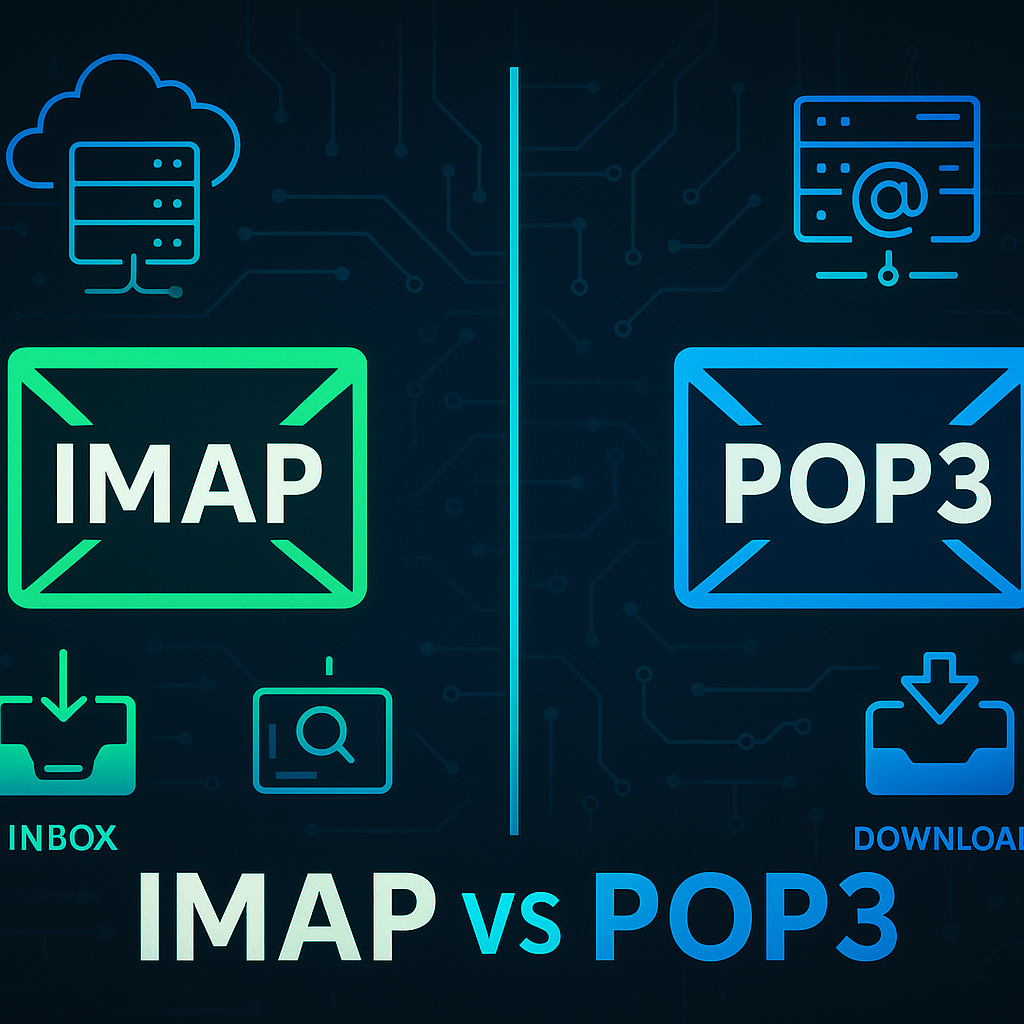
IMAP keeps the mailbox and folders on the server, then synchronizes their state with the client. It is generally the practical choice for Multi-Device access. Clients can cache selected data locally for Offline Access, while the primary mailbox remains on the server.
03 — POP3 and offline access
POP3 downloads messages to a client, commonly from the Inbox. A POP3 client can remove downloaded messages from the server or be configured to leave a copy. This makes its retention and backup behavior especially important, and usually less convenient for several devices.
04 — SMTP sends mail
IMAP and POP3 do not send messages to the mail server. A mail client uses SMTP for outgoing mail, commonly through an authenticated submission service. Do not assume incoming and outgoing server names or encryption settings are identical.
05 — IMAP and POP3 comparison
| Criterion | IMAP | POP3 |
|---|---|---|
| Synchronization | Server folders and message state synchronize. | Mainly downloads messages to the client. |
| Multiple devices | Usually suitable. | Needs careful leave-on-server settings. |
| Server storage | Generally higher because mail remains on the server. | Can be lower when messages are removed after download. |
| Backup | Server mailbox, retention, and client cache. | Local client data and retained server copies. |
| Organization use | Common for synchronized mailboxes. | Suitable for simple local-download scenarios. |
| Security | Use TLS and the provider’s supported authentication method. | |
06 — Test
- Configure the mail client with the provider’s exact secure settings.
- Send a test message through SMTP and verify receipt on a second device.
- For IMAP, confirm folder and read-state synchronization. For POP3, confirm the selected server-retention behavior.
Troubleshooting
- Authentication failure: recheck username format, required modern authentication, and whether POP3/IMAP is enabled for the mailbox.
- TLS failure: verify server name, port, device time, and the trusted certificate chain.
- Messages absent on another device: check POP3 removal settings or IMAP folder subscriptions.
Best Practices
- Prefer IMAP for standard multi-device mailboxes.
- Require TLS, use provider-supported authentication, and disable unused legacy access where policy permits.
- Define quota, retention, backup, and tested restore procedures independently of the selected protocol.
Frequently Asked Questions
Is IMAP a sending protocol?
No. IMAP retrieves and synchronizes mail; SMTP sends mail.
Does POP3 always delete mail from the server?
Many clients can leave copies on the server, but the selected behavior must be tested and backed up.
Conclusion
IMAP is normally the practical choice for synchronized mail across several devices; POP3 remains useful for specific local-download cases. In either case, use secure provider-approved settings and maintain tested backups.