Introduction
VMware vSphere provides two main virtual-switch types: vSphere Standard Switch (vSS) and vSphere Distributed Switch (vDS). Both connect virtual machines, VMkernel adapters, and physical uplinks, but their management model and capabilities differ.
01 — What Is a vSphere Standard Switch?
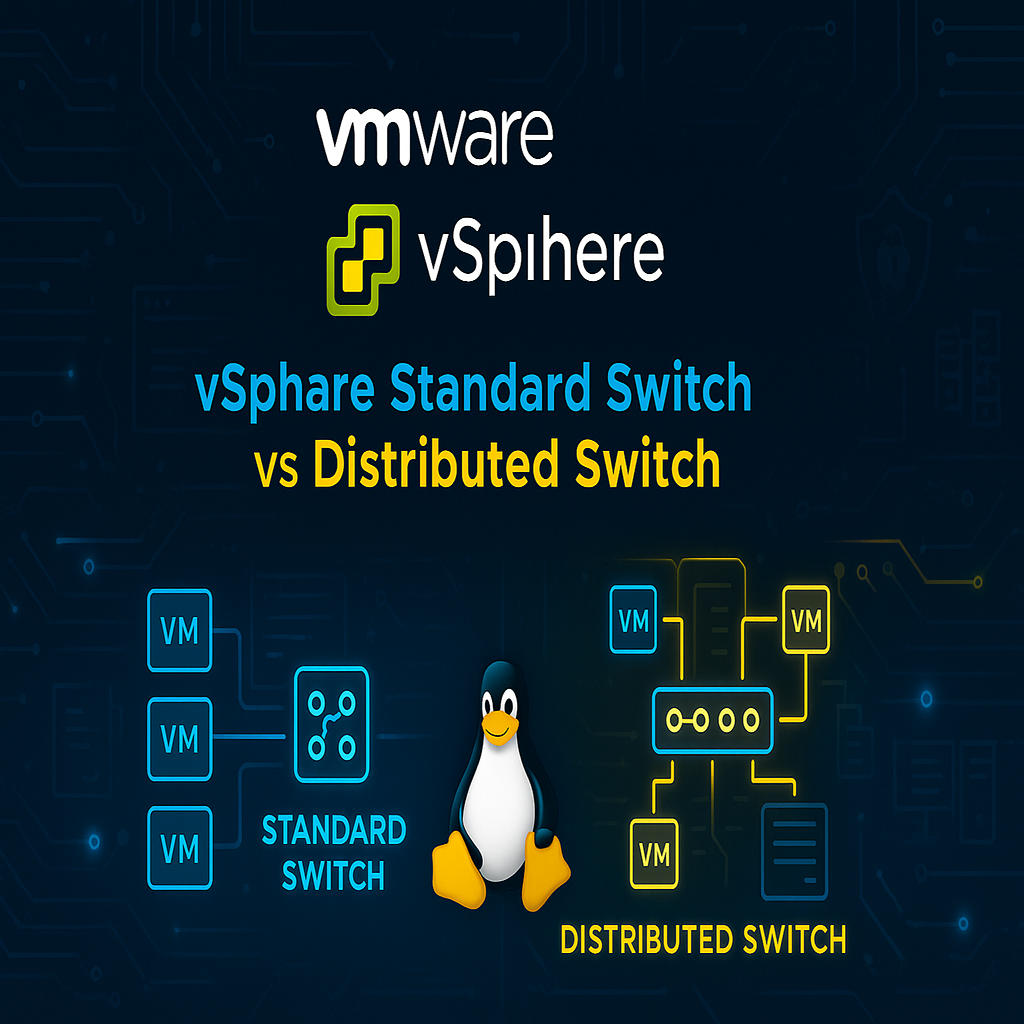
A vSphere Standard Switch is configured and stored independently on each ESXi host. In an environment with multiple hosts, administrators must create and maintain the required port groups, VLAN settings, and policies on every host that needs them. Consistent switch and port-group names are important when workloads must move between hosts.
02 — What Is a vSphere Distributed Switch?
A vSphere Distributed Switch is managed centrally through vCenter Server. Hosts that join the vDS use the shared switch configuration, and distributed port groups provide a consistent configuration across participating hosts. Virtual machines and VMkernel adapters can connect to these distributed port groups.
03 — Comparison
| Feature | vSS | vDS |
|---|---|---|
| Management | On each ESXi host | Centralized in vCenter |
| VLAN | Supported | Supported |
| NIC Teaming | Supported | Supported |
| Outbound Traffic Shaping | Supported | Supported |
| Inbound Traffic Shaping | Not supported | Supported |
| Private VLAN | Not supported | Supported |
| LLDP | Limited or unavailable | Supported |
| Suitable for a small environment | Yes | Usually not required |
| Suitable for a large cluster | More difficult to manage | Yes |
04 — Port Group and Distributed Port Group
A Standard Port Group belongs to a vSS on one host and provides settings such as VLAN and security policies for connected virtual-machine adapters or VMkernel adapters. A Distributed Port Group belongs to a vDS and acts as a shared configuration template for distributed ports across the member hosts.
05 — Uplink and VMkernel
vmnic and uplink
A vmnic is a physical network adapter detected by ESXi. An uplink connects a virtual switch to one or more vmnic adapters so traffic can reach the physical network.
vmk0 and management
vmk0 is commonly the first VMkernel adapter created for the ESXi Management Network. Its connectivity is needed to administer the host through the management interface.
vMotion and storage networks
vMotion and storage services use VMkernel adapters connected to the appropriate network. Keep their network design, VLAN assignment, and physical connectivity consistent across the hosts that participate in the service.
06 — When Should You Choose vSS?
Choose vSS for a small or simple environment, an independent host, or a scenario that does not depend on vCenter Server. It is suitable when host-by-host management is acceptable and advanced distributed-switch capabilities are not required.
07 — When Should You Choose vDS?
Choose vDS for multi-host clusters that benefit from centralized management and consistent policies. It is appropriate when the design needs features such as Distributed Port Groups, Private VLANs, LLDP, inbound traffic shaping, and advanced distributed networking capabilities.
08 — Migration Considerations
Plan a staged migration from vSS to vDS. Create the required distributed port groups and confirm VLAN and uplink assignments before moving workloads. Do not move all uplinks and vmk0 at the same time without a tested plan, because the host can lose Management Network connectivity. Migrate in controlled steps and verify connectivity after each change.
Protect management connectivity
Keep a recovery path, such as console or DCUI access, available throughout a networking migration.
Best Practices
- Use consistent switch, port-group, VLAN, and VMkernel naming across hosts.
- Document the physical vmnic-to-switch-port connections and the intended uplink assignments.
- Use separate, appropriately designed networks for management, vMotion, storage, and virtual-machine traffic when required by the environment.
- Test a design or migration on one host first and keep console access available for recovery.
Troubleshooting
Management connectivity was lost
Use console or DCUI access to review vmk0, its port-group assignment, uplinks, VLAN settings, and the physical switch configuration.
A VM has no network access
Confirm that the virtual NIC is connected to the intended port group and that its VLAN configuration matches the physical network path.
An uplink is unavailable
Check the vmnic link state, cable and physical switch port, and verify that the assigned uplink is available on the selected switch.
Policies differ between hosts
Review the local vSS and port-group configuration on every affected host, or use a vDS where centralized policy consistency is required.
Frequently Asked Questions
Can vSS use VLANs and NIC Teaming?
Yes. Both vSS and vDS support VLAN segmentation, multiple uplinks, and NIC Teaming.
Does vDS require vCenter Server?
Yes. vDS configuration is managed centrally through vCenter Server.
Why should vmk0 not be moved with every uplink at once?
An incorrect migration can disconnect the Management Network. Move networking in controlled stages and keep a recovery path available.
Conclusion
vSS is a practical choice for independent hosts and simple environments, while vDS is designed for centrally managed multi-host environments that need consistent policies and advanced networking capabilities. Choose according to the size of the environment, management requirements, and the services your network design must provide.