
1. The difference that matters
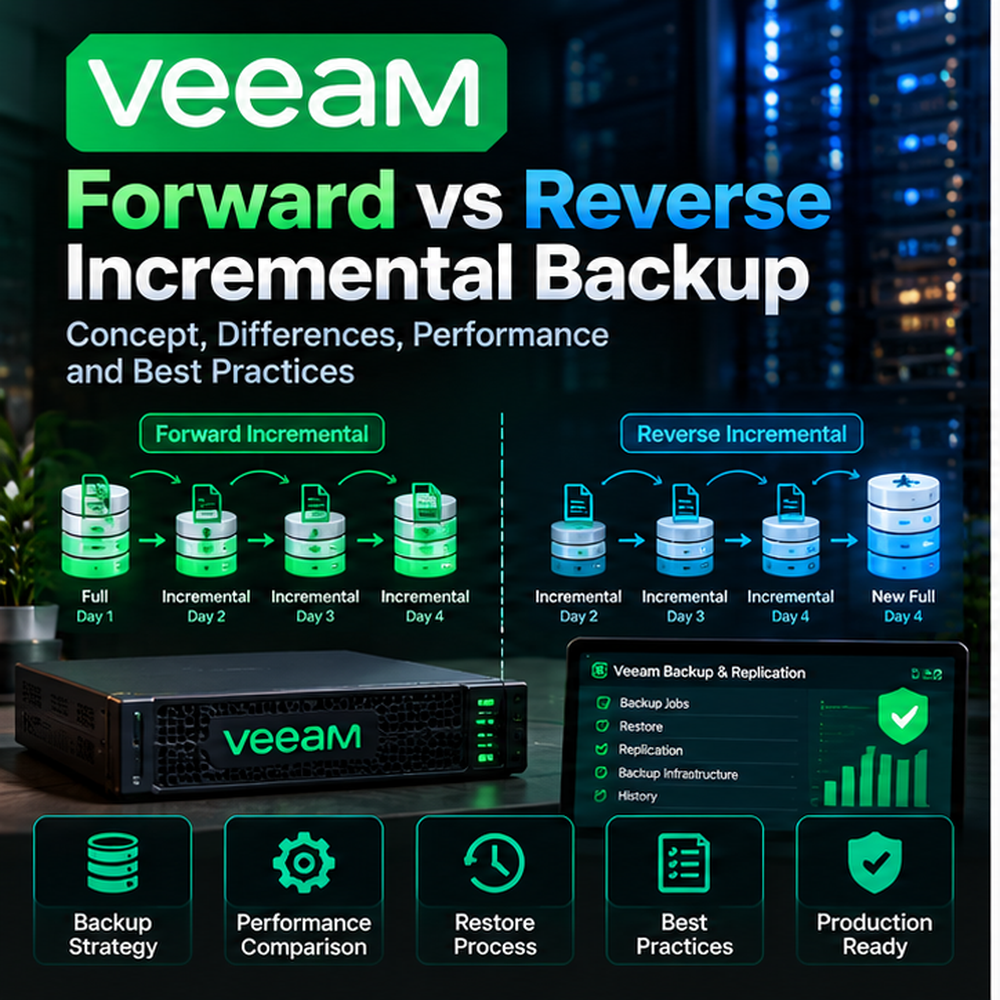
Forward keeps a full at the beginning of a chain and records later changes. Reverse keeps the latest state in a full and records rollback data. Both start with a full; subsequent incremental sessions transfer changed blocks rather than a fresh full image.
against official Veeam documentation. Starting with Backup & Replication 13, Reverse Incremental is deprecated; existing jobs with the option already enabled still work. Treat it as a legacy design, not a new deployment choice. This article describes VM backup chains; do not assume identical options for agents, NAS or direct object-storage workflows.
2. Where each method fits—and where to avoid it
The following choices are practical design inferences from the documented behavior. Validate them against your exact job type, repository capabilities and measured recovery requirements.
| Scenario | Preferred choice | Reason / avoid |
|---|---|---|
| New Veeam 13 deployment | Forward with periodic fulls | Do not build a new design around deprecated Reverse |
| Immutable Linux Hardened Repository | Forward + Active or Synthetic Full | Reverse and Forever Forward cannot be selected |
| Slow or high-latency target | Usually Forward; evaluate full creation | Avoid Reverse without a measured capacity case |
| High change rate and concurrency | Usually Forward | Reverse read/write work can become a bottleneck |
| Limited space on a mutable disk repository | Evaluate Forever Forward | The retention merge must fit the backup window |
| Source or network cannot sustain frequent full reads | Evaluate Forward + Synthetic Full | Avoid frequent Active Full without capacity |
| Independent new reads from source are required | Forward + Active Full | Reserve time, bandwidth and storage |
| Existing Reverse job; fast target; latest recovery priority | Temporary continuation after review | Measure recovery and plan migration |
| Deduplication appliance | Follow device-specific Veeam guidance | Do not assume arbitrary random rewrites are efficient |
3. Before selecting a backup method
Record the Veeam version, workload type, repository filesystem, immutability requirements, retention and daily change volume. Confirm whether Fast Clone is available. Reserve enough capacity for both retained chains and scheduled full operations.
4. Why incremental backups are useful
Repeated full backups consume source read capacity, network bandwidth and repository space. Incremental backups retain multiple restore points while transferring changes. CBT can identify changed blocks for supported VM backups. The chain method determines how those changes are stored and what restore depends on.
RPO is the acceptable amount of data loss and depends on successful backup frequency. RTO is the acceptable recovery time. Choosing Reverse does not automatically improve RPO; a short restore dependency does not guarantee meeting RTO without measuring an actual recovery.
5. Forward Incremental: restore moves forward
The first session writes a VBK full. Later sessions write VIB files with changes since the previous backup. To restore day 4 below, Veeam needs the day 1 VBK and the required day 2, 3 and 4 VIBs. Day 2 needs only the full and its first increment.
Day 1: Full.vbk
Day 2: Changes.vib
Day 3: Changes.vib
Day 4: Changes.vib
Restore day 4: VBK + required VIBs through day 4
In Veeam terminology, Forward Incremental with periodic fulls creates a new chain whenever an Active or Synthetic Full is created. These shorter chains limit dependency on earlier chains. Restore reads the required backup blocks; it does not necessarily create a separate full file first.
6. Protect the recovery points
For an immutable Linux Hardened Repository, use Forward with periodic Active or Synthetic Full. Changing a chain method alone does not make backups immutable. Protect repository access and keep a separately protected copy; verify recovery rather than assuming that a full file is healthy.
7. Reverse Incremental: keep the latest full
After the initial full, each successful session injects new blocks into the VBK. Replaced old blocks are saved in VRB rollback files. The current full therefore represents the latest restore point. Older restore points require that full and the relevant reverse increments.
After day 4:
Latest.vbk = day 4
Rollback VRBs = transitions to days 3, 2 and 1
Restore latest: VBK
Restore day 2: latest VBK + required VRBs back to day 2
Its historical attraction was a full for the latest recovery without reading the whole source daily. The cost is repository read/write work during each backup. Slow target storage can reduce throughput and extend the time VM snapshots remain open, especially with high change rates and concurrent jobs.
8. Side-by-side technical comparison
| Criterion | Forward with periodic fulls | Reverse |
|---|---|---|
| Files | VBK + VIB | VBK + VRB |
| Full position | Beginning of each chain | Latest restore point |
| Incremental session | Write a new VIB | Update VBK and write VRB |
| Latest recovery | Base full + required VIBs | Latest VBK |
| Older recovery | Full for that chain + VIBs to target | Latest full + rollback VRBs |
| Daily repository work | Mostly new incremental writes | Read old blocks, write rollback and new blocks |
| Space pattern | Periodic fulls and overlapping chains | Current full plus reverse increments |
| Retention | Old chains remain until dependencies allow removal | Expired oldest reverse points can be removed |
| Immutable Hardened Repository | Supported with periodic Active or Synthetic Full | Cannot be selected |
| Veeam 13 | Available for new designs | Deprecated; existing enabled jobs continue |
These are dependency and workload differences, not fixed speed ratios. Restore time depends on storage, destination and restore type. Space also depends on change rate, compression and block sharing; a VRB is not guaranteed to have the same size as a VIB.
9. Active, Synthetic and Forever Forward
| Method | How it works | Main cost or limitation |
|---|---|---|
| Active Full | Read the full backup data again from source | Source reads, network transfer and target writes |
| Synthetic Full | Build a full from existing repository backups | Repository processing; Fast Clone may reduce work |
| Forever Forward | One initial full; merge the oldest increment into it at retention | Merge I/O; unavailable on immutable Hardened Repository |
Incremental selected without scheduled Active or Synthetic Full means Forever Forward. Its full advances to the oldest retained point, not to the latest point as in Reverse. This distinction matters when planning capacity and immutability.
10. Advantages and disadvantages
| Method | Advantages | Disadvantages |
|---|---|---|
| Forward + periodic fulls | Clear chain structure; new files; periodic chain boundaries; hardened compatibility | Full storage and processing costs; dependent restore files; overlapping retention |
| Forever Forward | Fewer full files; no scheduled full source reads | Merge workload; mutable base; dependency on chain health; hardened restriction |
| Reverse | Latest recovery data is in one full; incremental source transfer | Target read/write pressure; old restores depend on VRBs; full changes each run; deprecated |
A missing or corrupt required VIB can prevent dependent forward restores; earlier independent points may remain usable. A missing required VRB can prevent rollback through that transition while the latest full may remain usable. Corruption of a base/current full can affect many dependent points. None of these methods replaces integrity checks or a separate protected copy.
11. Retention and a capacity example
A retention setting of 14 points does not guarantee exactly 14 files or points on disk in Forward mode. A full cannot be removed while retained increments depend on it. Old chains may overlap a new chain until deletion is safe; immutability can delay removal further.
Illustrative decimal units; stored Full = 1000 GB; each increment = 50 GB
1 full + 13 increments = 1000 + 13 * 50 = 1650 GB
2 fulls + 12 increments = 2 * 1000 + 12 * 50 = 2600 GB
This is file-volume arithmetic, not production sizing or a guarantee of physical consumption. Add room for chain overlap, full construction, maintenance and growth. ReFS/XFS Fast Clone can let synthetic fulls share blocks, so logical file sizes can exceed physical usage. Measure the actual stored increments and free-space peaks.
12. Diagnose backup and retention problems
| Symptom | What to check |
|---|---|
| Backup slows down on Reverse | Target latency, IOPS, concurrent jobs and changed data volume |
| More points than configured | Chain dependencies, newer fulls and immutability expiry |
| Restore point cannot be read | Required VBK/VIB/VRB availability and health; test another protected copy |
| Synthetic Full is slow | Fast Clone availability and repository load during full construction |
13. A practical selection checklist
Start a new deployment with Forward and periodic fulls. Choose the full type and schedule only after checking source capacity, target throughput, space and retention. For a mutable repository with tight capacity, compare Forever Forward and its merge time. Keep Reverse evaluation limited to existing jobs.
Before accepting the design, record backup duration, snapshot duration, repository latency and peak space. Restore both the latest and an older point, verify application data, and record recovery time. A successful backup job alone is not evidence that the required recovery works.
14. Choose for your recovery requirement
For new Veeam 13 designs, start with Forward and periodic fulls. Forever Forward is an alternative for suitable mutable repositories when merge performance and capacity justify it. Reverse remains a legacy-job consideration. Accept the design only after both recent and older recovery tests meet your requirements.
15. Frequently asked questions
Does Reverse download a full every day? No. Incremental runs transfer changes and update the stored full. Does it always restore faster? The latest point has fewer file dependencies, but measured end-to-end performance determines the result.
Is Forever Forward the same as Reverse? No. Its retention merge advances the oldest retained full, while Reverse updates the full to the newest state. Can either be selected for an immutable Hardened Repository? No; use Forward with periodic Active or Synthetic Full according to Veeam requirements.
16. Official References and downloads
Reverse Incremental: deprecated from v13
Forward methods and retention animation
Why retention can keep extra restore points
Hardened Repository limitations
Backup method performance guidance